
In spite of irritants and hiccups in the relationship, a few deliverables are expected of the prime minister's visit to China, says Rup Narayan Das.

While we are prepared to help the Chinese catch up with us in IT, they are not prepared to help us catch up with them in the engineering sector. They consider us rivals.
Janata paty chief Subramanian Swamy said that there was a possibility that India and China may get sucked into a serious border conflict by 'miscalculation and self fulfilling hype'.
"China and India are partners of development instead of rivals. There is enough space for the two countries to grow and prosper together," Zhang said at a reception in his honour hosted by Unity International Foundation on Thursday evening. China has always attached great importance to the development of Sino-Indian relations, he said, adding "we hold that the two countries have more consensus than differences."
Sino-Indian strategic relations are expected to get further fillip during the second innings of Chinese Communist Party chief Hu Jintao, who is all set to offer a red carpet welcome to Congress president Sonia Gandhi in Beijing this week.

Arunachal Pradesh MP Tapir Gao underscores the critical importance of heeding local warnings regarding alleged Chinese incursions along the Line of Actual Control, amidst ongoing border tensions and official denials.

'China's excessive military aid to Pakistan is the real elephant in the room as far as Sino-Indian relations are concerned. India should be confident enough to accept a degree of closeness between China and Pakistan, since China may wish to use this link for its foray into the Muslim world.' 'But the Chinese must be realistic enough to know that as time passes, the tactic of using Pakistan as a proxy to check India will yield diminishing returns. The US tried it for 60 years but failed, so will China,' says Colonel Anil A Athale (retd).

'After the Galwan clash, the rules of engagement changed with the army commanders allowed to use any means at their disposal as they deem fit for tactical operations.'

Prime Minister Manmohan Singh has said that commitment by Indian and Chinese leaderships to maintain peace and tranquillity at borders pending boundary settlement is an important guarantor for further progress in Sino-Indian ties, particularly growth of 2.5 billion people.
Suggesting Sino-India relations have implications for the world at large, Prime Minister Manmohan Singh Monday pitched for "greater substance and further depth" in bilateral ties.

For the foreseeable future, the most likely outcome remains continuation of the status quo. Taiwan will remain self-governing without formally declaring independence, while China continues to apply sustained pressure short of war, predict Krishnan Srinivasan and Manoj Mohanka.

The fierce battles of Galwan, Rezang La, Gurung Hill, and Walong taught the PLA a hard lesson: Fighting the Indian Army would never be easy or inexpensive.

Congress general secretary Jairam Ramesh has alleged that the BJP's "real and ultimate target" in seeking a two-thirds majority in the Lok Sabha is to amend the Constitution to end reservation, rather than genuinely implement women's reservation.

Through his commitment to democratic norms, debate, dissent and constitutionalism, Jawaharlal Nehru helped ensure that parliamentary democracy took deep root in independent India. Utkarsh Mishra evaluates Nehru's 17 years as India's first prime minister, examining his role in nation-building, democratic institution-building, economic planning, scientific advancement and foreign policy.

India would confront a more entrenched China, a less dependable United States, and a regional order increasingly shaped by great-power bargaining over which it exercises limited influence, notes Amberish K Diwanji.

'China continues to perceive its relations with India through the prism of India-US relations, with the US using India to counter balance against China in the Indo-Pacific and beyond.'

China has welcomed the appointment of Vikram Doraiswami as the new Indian Ambassador, expressing optimism for improved Sino-India relations. Doraiswami, a seasoned diplomat with experience in China, is expected to play a key role in managing complex bilateral issues and fostering cooperation.

Sheela Bhatt, who is travelling with Prime Minister Manmohan Singh on his two-nation visit, analyses the outcome of crucial talks between the PM and his Chinese counterpart in Beijing.
India and China have some striking similarities and quite deep differences.

In a rare gesture, China's official media in Beijing on Tuesday extended its biggest coverage to an Indian political event projecting Narendra Modi's takeover as Prime Minister as a harbinger of "big boost" to China-India relations.
The tense atmosphere between India and China has changed for good after the Copenhagen summit, claimed a top-level source dealing with the Chinese in Indian government.
Describing her ongoing visit to China as a milestone in Sino-Indian relations, Congress president Sonia Gandhi on Friday said that she was 'amazed and astounded' at the progress made by the neighbouring country. Gandhi's first political engagement, on the second day of her five-day visit, was a meeting with Wang Jiarui, the Minister of the International Department of the ruling Communist Party of China. Wang told her, "Your visit has captured the world's attention."
With Copenhagen summit providing India and China the much-needed turn around in their relations after a public spat over Arunachal Pradesh, the two sides will try to use External Affairs Minister S M Krishna's April 5 visit to firm up the understanding and not let tensions return to haunt their ties.

Prime Minister Narendra Modi and Chinese President Xi Jinping are expected to hold bilateral meetings on the sidelines of the SCO summit in Tianjin, as both nations look to strengthen ties amid global trade tensions.

The logic of war plus the gathering storms in US politics as the midterms loom large leave him with no real alternative but to negotiate, points out Ambassador M K Bhadrakumar.
The Tibet issue should not become a barrier in the bilateral relations between India and China, Prime Minister of the Tibetan government-in-exile Professor Samdhong Rinpoche said on Tuesday.
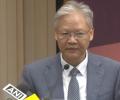
Chinese envoy Xu Feihong stated that China opposes the US imposing tariffs on India, amidst a thaw in Sino-India relations and concerns over global trade disruptions.

He is due to call on Premier Li Keqiang later on Thursday and hold talks with China's Public Security Minister Guo Shengkun, who is also the State Councillor in the CPC, a rank above the minister.

The ITBP guards the 3,488 km long Line of Actual Control between India and China, along with the Indian Army.
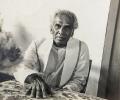
What appeared to be a generous act of friendship was, in truth, a manoeuvre within a much larger strategic game. The United States used the 1962 war not just to aid India but to test how far it could be pulled into the Western fold, points out Dr Kumar.
Ahead of his visit to Beijing, Prime Minister Manmohan Singh on Monday said India-China relations are in "very good shape" and negotiations are underway to resolve the "complicated" border issue.
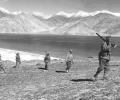
As India and China continue to face off across the Himalayas six decades later, the echoes of that earlier conflict remain unmistakable. The core of China's sensitivity lies not in maps or mountain passes, but in its perception of sovereignty over Tibet, points out Dr Kumar.

A close scrutiny of speeches and documents during Chinese premier Li Keqiang visit indicate that, while there are gains for both Beijing and New Delhi, overall China's diplomacy scored more points, says Srikanth Kondapalli.

India emerged from the war militarily bruised and strategically altered. The United States, under the guise of friendship, had succeeded in achieving what open alignment never could: The psychological and political repositioning of India within the Cold War order, points out Dr Kumar.

'There are times when India should stand up without hesitation and voice its indignation over the US' pressure tactic. This is one such moment,' asserts Ambassador M K Bhadrakumar.
Kasuri also sounded optimistic over the recent foreign secretary level talks between India and Pakistan.
He said Pakistan to take cue from the approach that India and China have adopted to resolve their differences.
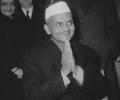
He chose what was best for India, not for himself. Few can deny that when god took Shastri away so soon, they did India an injustice, points out Harishchandra.
